
Graduate Careers | The Scholar’s Pivot: From Thesis to Venture
Introduction
This resource is designed to reframe academic rigor as entrepreneurial grit. As a doctoral (or master's) candidate at Howard, graduate students already know firsthand that a PhD isn't just about a dissertation—it’s about high-level project management, critical inquiry, and resilience.
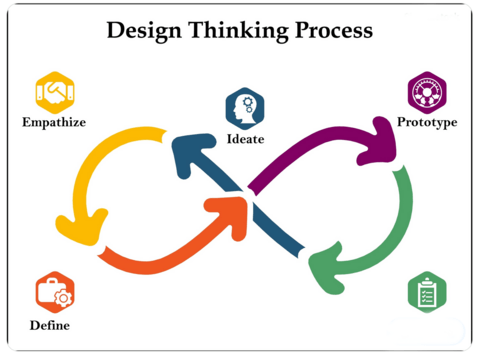
This infographic illustrates the five stages of the design thinking process. Design thinking is a human-centered, non-linear, iterative process used by design teams to better understand and creatively solve complex problems through understanding users, challenging assumptions, redefining problems, and creating innovative solutions. The process is depicted as a continuous loop, emphasizing its iterative nature, with five key stages: Empathize, Define, Ideate, Prototype, and Test.
- Empathize | The first stage of the process, represented by a handshake icon, is to empathize with users. This involves gaining a deep understanding of the target audience's needs, wants, and pain points through observation, interaction, and immersion. By putting themselves in the users' shoes, designers can build a solid foundation for creating user-centric solutions.
- Define | Next, designers move to the define stage, symbolized by a briefcase icon with a gear. In this phase, the information gathered during the empathize stage is analyzed and synthesized to define the core problem from a human-centered perspective. A clear problem statement is crafted, which will guide the rest of the design process.
- Ideate | The ideate stage, represented by a head with gears, is where creativity flourishes. Designers brainstorm a wide range of potential solutions to the defined problem. The goal is to generate as many ideas as possible, encouraging thinking outside the box and exploring unconventional approaches.
- Prototype | Following ideation, the prototype stage, symbolized by a life preserver icon, involves creating scaled-down, inexpensive versions of the product or specific features. These prototypes can range from simple paper mockups to interactive digital models. The purpose is to experiment with and test potential solutions before investing significant resources.
- Test | The final stage in this depiction is to test the prototypes with users, represented by a clipboard icon. This phase provides valuable feedback on what works and what doesn't, allowing designers to refine their solutions. The insights gained from testing often lead back to earlier stages of the process, highlighting its iterative nature.
Resources
- Howard University | Howard University and PNC National Center for Entrepreneurship | https://business.howard.edu/centers/PNCentrepreneurship
- Howard University | Small Business Development Center| https://business.howard.edu/centers/small-business-development-center
- Boots to Business | Boots to Business (B2B) is an entrepreneurial education and training program offered by the U.S. Small Business Administration (SBA) as part of the Department of Defense’s Transition Assistance Program (TAP). The VBOC encourages TAP-eligible and active duty personnel, military spouses, veterans and civilians with base access to attend this free 2-day introduction to entrepreneurship training class covering topics you need to consider before and as you start your business. For those do not have access to a military installation, Boots to Business Reboot (B2BR) provides an overview of business fundamentals and techniques, more information here, https://sbavets.force.com/s/reboot-course-information
- For a calendar of classes by type and/or by state, visit: https://sba.my.site.com/s/
- For more information on the Boots to Business program and SBA’s Office of Veteran Business Development, visit https://www.sba.gov/sba-learning-platform/boots-business
- Black Venture Capital Consortium | BVCC is a nonprofit organization whose mission is to increase diversity in the Venture Capital & Startup Ecosystem. More information: https://www.bvcc.vc.
- The HBCU Startup Labs (LABS) | This project is a center of excellence for a community of entrepreneurs, innovators and disruptors. As a partner with business schools and S.T.E.M. departments at HBCUs, LABS has a mission of driving forward-thinking technological development through aggregation and collaboration. LABS and partnering institutions have an opportunity to create a virtual platform to increase minority interest in engineering, business, computer science, health and natural sciences. LABS has a mission to intimately connect and support HBCU students, staff and alumni with the technology transfer industry thus creating disruptive companies, workforce development and thriving traditionally-underrepresented communities. More information: https://www.hbcustartup.com.
- HBCUvc | Its work is rooted in the legacy of Historically Black Colleges and Universities—institutions that opened doors where none existed and built ecosystems grounded in community, trust, and shared advancement. Inspired by that legacy, HBCUvc takes a Black-forward approach that centers the experiences and potential of Black founders and investors while welcoming all who align with our values and vision. The organization believes that innovation thrives in communities that have historically been overlooked and undercapitalized. By activating new investors, cultivating trusted relationships, and strengthening the networks through which capital moves, we help ensure that Black innovators—and the broader ecosystems they influence—are visible, supported, and connected to the opportunities they deserve. Annually, HBCUvc offers a Start-up School for recent grads and alumni. More information: https://www.hbcu.vc.
- HBCU Startup Open | https://www.hbcustartupopen.com
- HBCU Start-up School | https://www.hbcufutures.org
- National HBCU Entrepreneurship Conference | https://hbcuempower.com
- HBCU Founders Initiative | Launched by Nex Cubed, the HBCU Founders Initiative (HBCUFI) is a nonprofit that empowers entrepreneurs from HBCUs to create tech-enabled solutions, addressing challenges on campus, nationwide, and abroad. Their core thesis is that by providing underresourced innovators at HBCUs (Historically Black Colleges and Universities) with access to capital and curriculum to scale their startups, they can help reduce the wealth gap that has persisted for generations – through the power of entrepreneurship. To date, over 1,500 students and alumni from 80+ HBCUs have participated in the HBCUFI programming. More information: https://www.hbcufi.org.
- HBCU Money | https://hbcumoney.com
- Nex Cubed | Black, Female and Latin founders receive less than 2% of all venture capital funding. Their mission is to help support and accelerate the success of underrepresented founders, and to promote diversity, equity and inclusion in the startup ecosystem. More information: https://www.nex3.com
Incubators - The What and the Why
Graduate students would not conduct their doctoral research without a lab, a library, or a mentor. Building a business requires a similar ecosystem. An incubator is a collaborative program designed to help early-stage startups—even those that are currently just an idea in a dissertation—survive and grow.
At Howard, this means taking your high-level research and giving it the "business oxygen" it needs to thrive.
Follow this link for detailed resources on the incubation process.