Bison Trailblazers | The Scholar’s Pivot: How Dr. Kevin E. Scriber II Transformed the PhD into a Global Passport
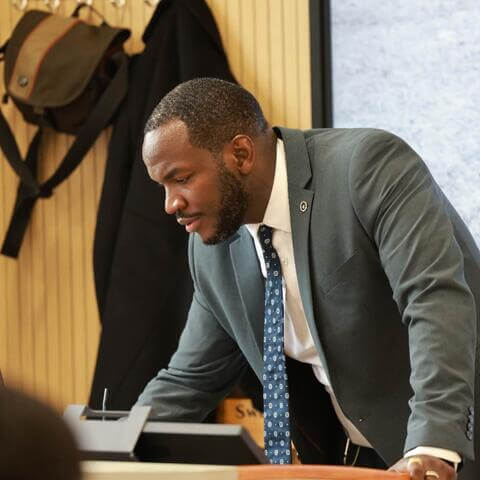
by Anna De Cheke Qualls
In the academic world, a "pivot" often refers to a change in research focus, but for doctoral alum Dr. Kevin Emmanuel Scriber II, the term describes a life lived across latitudes. From his current post at Texas A&M University, where he instructs the next generation of medical professionals in Anatomy and Physiology, the view is framed by a decade of global exploration that most scholars only read about in journals.
A Washingtonian who found his North Star in the stories of explorers from his own hometown, Scriber has transformed the traditional PhD path into a passport, building a career that bridges the Smithsonian’s elite research labs with international micro-campuses in the heart of China. His journey is a testament to the idea that true scientific mastery isn't found just in the data, but in the courage to teach and live in the spaces where the familiar falls away.
Foundations in the District
For Scriber, the journey to becoming a world-traveling academic began in Washington, D.C. A "Washingtonian" through and through, his early years in the D.C. public school system provided the spark for a life of exploration.
"I actually became interested in scientific exploration and research as a youth," Scriber recalls. "I learned about Matthew Henson, also a Washingtonian, who was integral to the expedition to discover the North Pole. Knowing that someone from my hometown, someone who looked like me, had reached the literal ends of the earth made the world feel accessible."
That sense of accessibility carried him through Norfolk State University and eventually to the University of Alabama at Birmingham (UAB). As a PhD student at Howard, Scriber didn't just stay in the lab; he used his research as a passport.
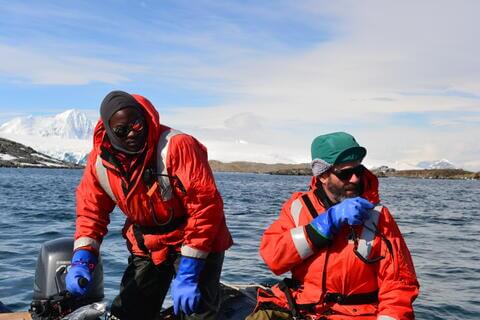
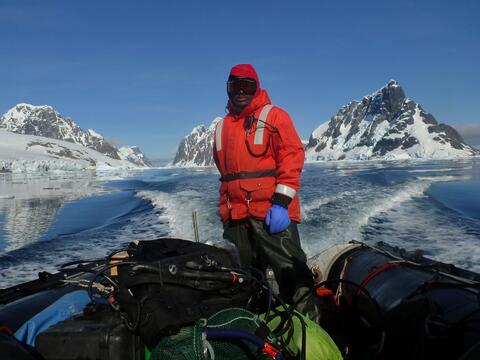
"As a graduate student, I was able to travel, conduct research, and experience life in a number of localities around the world, including the Bahamas, Ecuador and the Galapagos archipelago, Chile and Antarctica, Uruguay, Hawaii, and throughout China," he says. "I was able to work at a number of museums in Montevideo, Uruguay; Honolulu, Hawaii; and the National Museum of Natural History in Washington, DC."
The Courage to Step Off the Map
Many scholars talk about "global engagement," but few pack their bags and move to the other side of the planet with no safety net. For Scriber, the first leap was the hardest—and the most necessary. When the opportunity arose to teach in China as a visiting professor for Auburn University at the age of 29, he didn't hesitate, despite the daunting distance.
"I have had few instances in my life that compare to the opportunity to travel to the other side of the Earth, site unseen," Scriber reflects. "I always thought that, in situations such as this, there is little chance this will happen again, so there is no real option aside from going through with it."
This philosophy of "going through with it" has become a mantra for his career. He argues that growth only happens at the edge of one’s comfort zone. "Furthermore, these situations in life for which one is uncomfortable are the situations that benefit us the most. We succeed or fall on our face. There is a certain clarity that comes with that kind of risk."
This risk-taking allowed him to conduct groundbreaking research for his PhD dissertation at Howard University while simultaneously serving as faculty in China. Between 2014 and 2018, he spent his summers studying the trophic ecology of invasive apple snails in Chinese ecosystems—a project that required him to be both a researcher and an educator in a foreign land.
A Master of the "Sino-American" Classroom
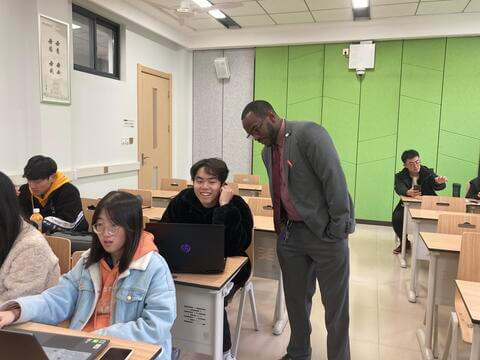
Scriber’s international experience is most deeply rooted in the "Sino-American" 3+1 dual-degree programs. These programs, which allow Chinese students to earn degrees from American institutions while remaining partially in China, require a unique kind of academic diplomacy. Scriber has taught in China seven times, eventually serving as a Global Professor for the University of Arizona’s micro-campus in Yangling, Shaanxi Province.
"I was the first full-time Global Professor hired by the Department of Environmental Science to develop courses and implement the curriculum in China," he explains. Scriber's role was as much about building an institution as it was about teaching. He assisted in the recruitment and integration of subsequent faculty, helping to bridge the gap between American academic standards and Chinese cultural contexts.
His success in these roles was staggering. Despite the language barriers and the rigors of a 12-to-18-hour teaching load per semester, Scriber maintained a 100% pass rate in his Statistics and Scientific Writing courses. He credits this to a student-centered, research-driven philosophy.
"I utilize the same teaching philosophy as I always have," he says. "Education is not just the accumulation of facts and figures; rather, it is most plainly manifested as a change in behavior. I have believed this since I first started teaching in 2013 and continue to now. This is something I learned from my Microbiology Professor at Norfolk State University, Dr. Patricia Ravenelle."
For Scriber, teaching is not a one-way street. "I have had the advantage of being closer in age to my pupils," he notes. "I still try and maintain an amicable ambiance in the classroom—one where free exchange of ideas and expressions can be cultivated. I have incorporated research into my teaching methodologies and students’ learning experiences, which has facilitated the growth of academic relationships and collaboration opportunities."
The Reality of Assimilation
While the professional accolades are impressive, Scriber is quick to point out that living abroad isn't just a series of photo opportunities. It is a grueling process of personal evolution.
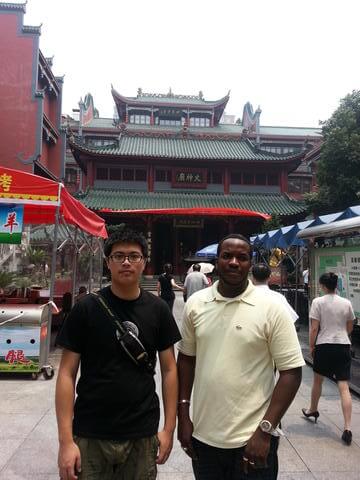
Scriber has worked abroad in various places: US Palmer Antarctic Research Station, the Gerace Research Center on San Salvador, Bahamas, the Charles Darwin Foundation throughout the Galapagos Archipelago, and the Centro Universitario Regional del Este (CURE) Institutes in Maldonado, Uruguay. In China, he has been at the Hunan's Central South University of Forestry and Technology (CSUFT) Changsha, Jiliang University and Xi Xi National Park in Hangzhou, the Northwest Agricultural and Forestry University and the Gansu Mountain Research Station. Through the University of Arizona's (UA) micro-campus in Yangling, Shaanxi, he has also lived in China for long periods of time.
"There are inherent difficulties with moving to another country," he says candidly. "The assimilation of new culture and language, maintaining ties with friends and family who are unaware of the changes to the person they knew in a land they do not, as well as gaining new ties... it changes you."
He speaks of a "thinning" of his social circle that occurred as he moved between continents. "In my case, the culture shock was eventually replaced by a feeling that the rough edges of my personality, and the growing wealth of my experiences, made evident that some relationships are meant to be outgrown. It’s hard to realize that the limitations of others’ growth will eventually start to affect your own."
He offers a stern piece of advice for those who feel held back by their environment: "Everybody cannot go with you. Some people are only meant to stay in their comfort zone and can only be happy within the status quo. Your ambition to see what’s over the next hill to some seems a sense of superiority. However, that is a projection of their own feelings. You don’t have to settle for mediocrity. Be the best of the best of the best that you can be."
Navigating Identity as a Black Academic
Being a Black man in high-level academic spaces in China and the U.S. brings another layer of complexity to Scriber's journey. He views his presence in these spaces as a responsibility, though one that comes with its own set of challenges.
"Being abroad as a Black man academic carries responsibility. It is also paving new pathways for others," he says. "There is always someone to remind you of who you are—whether that is a student who is surprised to see you in this position or those who would disparage you. The latter is often veiled behind a compliment or even the face of a friend."
How does he stay grounded in the face of such pressure? "It’s akin to a duck and water. I get much more from drawing support from my close friends and colleagues, whom I have known for years. Our circles change alongside our personalities and personas if we are not grounded. We forget who we are and where we come from. I cannot forget, because honestly, there are so few people left in my circle to remember."
The Polymath’s Toolkit
Scriber’s academic background is as diverse as his travel history. With two STEM teaching certifications and a TESOL (Teaching English to Speakers of Other Languages) certification, he is a "Swiss Army knife" of education. He moves between molecular techniques and statistical modeling with an ease that baffles those who prefer to stay in a single silo.
"I am a biologist, ecologist, a statistician, and environmental scientist; my research is variable and falls within the overlap of these disciplines," he explains. Scriber has taught more than fifteen different courses across six domestic and two international universities. Whether it’s "Data Analysis for Life Sciences" or "Principles of Ecotoxicology," Scriber’s focus is on practical, evidence-based instruction.
"I primarily use R Studio and teach students to utilize this program without the need to code," he says of his Statistics approach. "Being able to be malleable and work in an interdisciplinary fashion, where synergism is key rather than individual accomplishment, is of paramount importance."
A Global Perspective on the Human Condition
After years of living in different hemispheres, Scriber has come to a conclusion that is both scientific and deeply human. His travels have stripped away the "novelty" of different cultures to reveal a shared human core.
"It has made me a more well-rounded person," he reflects. "Not just that I have been places, but that I realize the social hierarchies and norms, as well as biases, we experience in America are not necessarily transferable, nor present, in other parts of the world. The same moon, sky, rain, snow, and sun with different people, who may speak a different language which represents the same compendium of human feelings."
As Scriber looks toward the future—currently focused on his faculty role at Texas A&M and several pending research grants—he remains a man defined by his curiosity and changing one's world. For him, this is the "Scholar’s Pivot." From the public schools of D.C. to the research stations of Antarctica and the classrooms of China, he has proven that the only true limit to a scholar’s potential is the one they place on themselves.
"Never limit your potential, or current opportunities, because of anyone," he concludes. "Other peoples’ ill-informed opinions of you do not dictate your reality. Cut these people out early. Be the best you can be."
More information about Dr. Kevin E. Scriber can be found here.