
Graduation Profile | The Digital Historian: Howard Grad Dr. Phillip Warfield on AI, Activism, and the Future of Academia
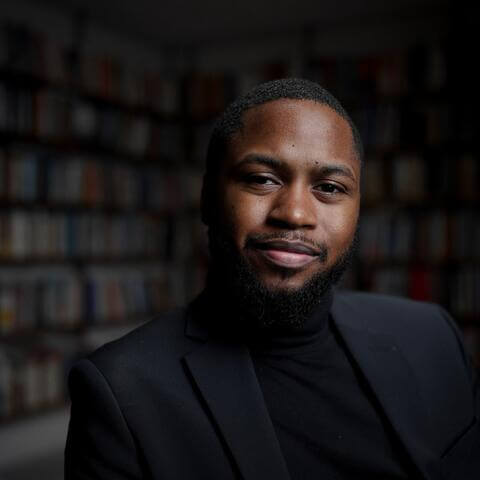
By Anna De Cheke Qualls
Dr. Phillip Warfield, a newly minted 2026 PhD graduate from Howard University’s Department of History, has always been a man on the move. Born in Tucson, Arizona, his childhood was a nomadic journey through states like New Mexico, Texas, Florida, Tennessee, and Louisiana. "I grew up a bit of a nomad," Warfield notes. This constant relocation, combined with a fierce love for '90s history-based video games and cartoons like Where in the U.S.A. is Carmen Sandiego?, planted the early seeds for his life's work. "Between video games surrounding history and my own nomadic life, I naturally grew to learning anything about wherever I was," Warfield reflects.
The Catalyst for Change
Warfield's academic and career trajectory was profoundly reshaped during his undergraduate years at a historically white institution. Serving as Student Association President, he championed a platform focused on highlighting the campus's racial diversity in tangible ways. However, the urgency of his mission was amplified in February of his second semester, when a former student interrupted a campus celebration for Black students by posting racist messages across social media.
Warfield's vocal response generated thousands of interactions online, prompting an emergency meeting with the President's Cabinet where he successfully demanded an institutional apology for the pervasive racism allowed on campus. While the administration initially obliged and promised to hire a Vice President of Diversity, Equity, and Inclusion, they reneged just a year later.
When Warfield pushed for proactive programs, a top-ranked administrator's response changed everything for him: "What will the white students get?". This jarring moment forced a reckoning. He realized that no matter the urgent needs of Black students, administrative decisions were often driven by politics rather than necessity. "The machine, which can include racist issues, may perpetuate even after you’ve helped right the ship," he notes of the undergraduate experience.
Finding a Home and a Voice at Howard
Seeking a deeper understanding of this historical struggle, Warfield found his academic home at Howard University. "At Howard University, I’ve thrived," he says. "I have found that the conversations I’ve been exposed to in the classroom and the kinds of questions students are allowed to ask has made my worldview that much stronger".
He dedicated his research to the history of Black students' protests within religious higher education, explaining, "I decided to research the history of Black students’ protests in religious higher education because I felt that I was that student". His professors gave him the permission to dive into the archives without having to justify his personal attachment to the work. "I wanted to know that I was not alone in my fight for racial justice at my religious, formerly racially homogenous campus," he explains.
His vital research bridges a critical gap, as he points out: "My research fills the gap between Black Power and religious studies". He notes that historians "have overrepresented secular colleges in Black students’ fight for racial justice on their campuses, but have not considered other inspirations that Black students have used as core elements of their arguments".
Hands-On History Beyond the Classroom
Outside the archives of Howard, Warfield deliberately built a resume designed to bring history directly to the public. During his time as an intern at the Smithsonian National Museum of African American History and Culture's Office of Curatorial Affairs, he mastered the art of curatorial storytelling, learning to craft resonant narratives based not just on historical objects, but on the physical layout of a given space.
His collaborative efforts extended to the Council of Independent Colleges’ Legacy of American Slavery Initiative. Through this work, Warfield saw the power of cross-institution collaboration firsthand, learning how professors and students can actively partner to help their respective campuses confront the legacy of the nation's gravest sin.
Additionally, Warfield ventured into the world of digital archiving. Working as an archivist for the Government of the District of Columbia, he gained highly practical experience digitizing massive amounts of material to ensure it remains accessible for researchers. This demanding role also taught him how to effectively navigate public interactions and manage the inevitable organizational setbacks that occur outside of a team's control.
The Digital Frontier
As he steps into the 2026 job market, Warfield is keenly aware of the rapidly evolving landscape. Graduate students, he notes, must lean heavily into their innate ability to problem solve and critically analyze. He cautions his peers against outsourcing their thinking to rapidly advancing technology: "In a time where AI is rapidly taking over the workspace, humans have to ensure that they don’t outsource all of their thinking to machine learning". He emphasizes that "Thinking, learning, and researching is a creative joy! Don’t outsource or cheapen your art and your research for the sake of prolific output".
Looking ahead five to ten years, he envisions leaving the traditional Ivory Tower to embrace front-facing roles. "Being a public intellectual is often still looked down upon; however, as our world continually questions the need for higher education, many of us should leave the Ivory Tower to pursue front-facing roles," he asserts. His goal is to build an online community connected not just to the research he produces, but to him personally as a creator who disseminates knowledge.
The Ultimate Productivity Hack
How did he manage the grueling demands of a PhD, internships, and activism? A strict boundary for rest. From Friday night to Saturday night, Warfield takes a complete break from work, school, and creative projects to enjoy food, family, and community. "Having a reset every week has been my biggest productivity hack, over everything else," he says.
As he graduates, his final advice to others navigating the rigors of academia and life is deeply grounded: "Honor the rest your body, mind, and soul need. You are not a machine. You are not in competition with everyone else—you’re in a mental battle against yourself".